What Frøya's Aquaculture Industry Taught Me About Long-Term Human Capital
When I moved to Frøya I came with a framework I had been testing for years and a set of questions I needed the island to help me answer. What I did not expect was that the industry defining the place would clarify something I had not thought to look at directly.
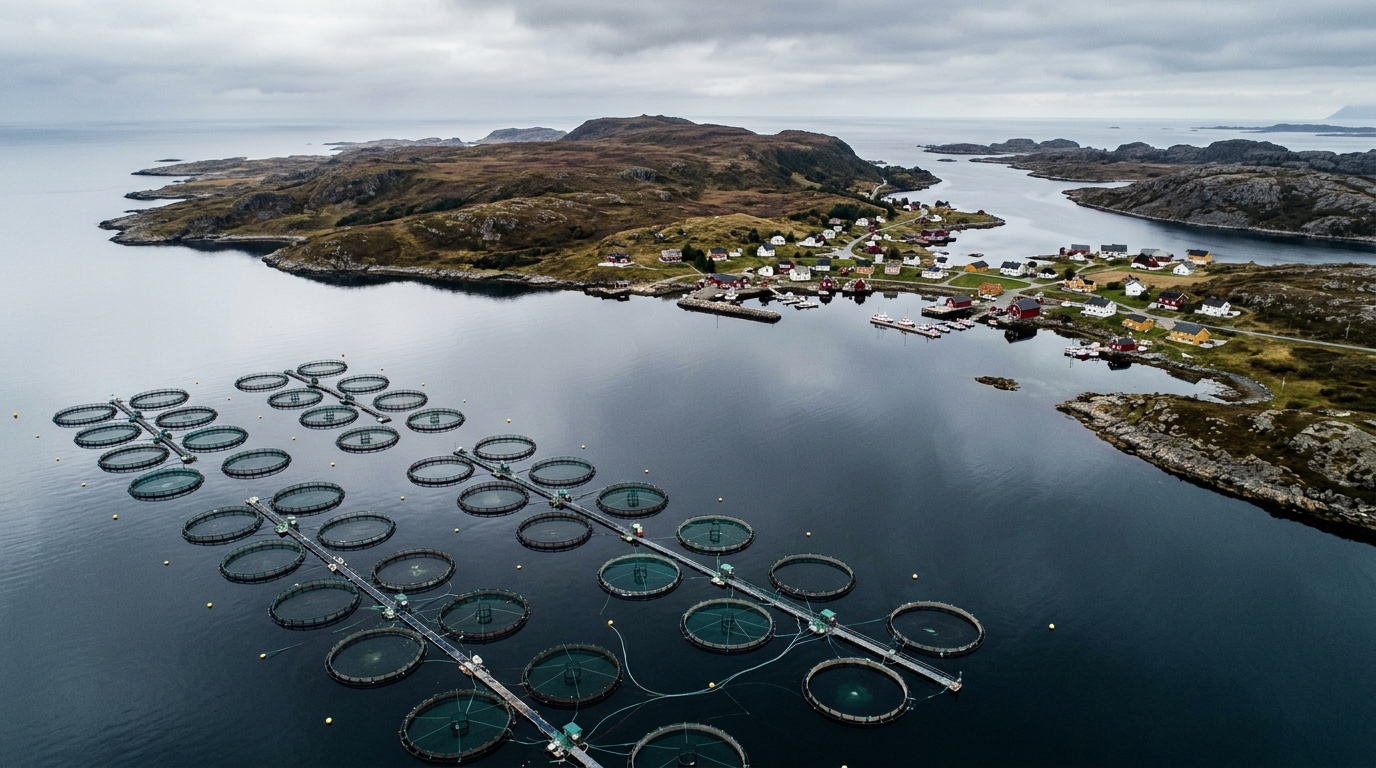
Aquaculture is not a background feature on Frøya. It is the economy, the employment base, and in many ways the identity of this island and its neighbour Hitra. Understanding how it works has been part of understanding where I live.
What I started noticing
The people who work in this industry are technically skilled in ways that are easy to underestimate from the outside. Biomass assessment, net inspection, equipment maintenance, feeding calibration, health monitoring for thousands of fish across multiple sites. These are not entry-level physical tasks dressed up as technical roles. They are genuinely complex, experience-dense jobs that take years to do well.
The knowledge is in the people. Not in manuals. Not in software systems, though some of it is increasingly being captured there. In the workers who have done the same sites across multiple seasons and know things about site behaviour, equipment patterns, and fish health that no data system currently holds.
That is human capital in the most literal sense. Knowledge embedded in people. Compounding with every season.
What I also noticed is that those same people are doing physically demanding work in cold environments across long shifts, and that the infrastructure to support the long-term physical sustainability of that work is largely absent. No structured physical preparation. No cold-environment recovery protocols built into the working pattern. No systematic tracking of the load accumulation that the research on seafood industry workers in North Norway documents clearly as a significant risk.
The Clarify step applied here
The first step in the Lion Ethos is clarify. Before building anything, you ask: what is actually happening here, and what is the real problem?
What is actually happening in Norwegian aquaculture is that some of the most valuable human capital in a critical export industry is being sustained without the physical infrastructure it needs to run for a full career. Workers in their 20s and 30s are accumulating joint wear and fatigue patterns that the research says will produce significant absence and attrition in their 40s and 50s. The operational knowledge those workers carry will leave the industry with them.
The real problem is not that the work is too hard. It is that the systems designed to support the people doing the work have not caught up with what the research knows about physical sustainability in this specific occupational profile.
Clarifying that is the starting point for building something useful.
Why this connects to what I came here to build
IPRESTANDA exists to close operational gaps in Norwegian businesses using AI and systems thinking. The workforce physical health gap in aquaculture is an operational gap. It has a data dimension, shift patterns and absence records that contain patterns nobody is currently reading. It has a systems dimension, no structured pathway from data to intervention to outcome. And it has a human dimension, the people doing the work.
The six-months piece was about what proximity to real conditions teaches you about strategy that abstract planning cannot. This is one of the clearest examples. Living here made the gap visible in a way that looking at the industry from the outside would not have.
The long-term human capital frame
Human capital is one of the most discussed ideas in business and one of the most poorly managed in practice. The management failure is almost always a time horizon problem. The costs of underinvesting in people accumulate over years. The returns from investing in them compound over the same period. Both are outside the quarterly or even annual view in which most operational decisions get made.
The aquaculture workforce on Frøya and Hitra represents concentrated, valuable, hard-to-replace human capital in an industry the Norwegian economy depends on. Extending the productive careers of those workers, reducing the physical attrition that currently costs the industry significant absence and turnover, and connecting that outcome to the operational systems that already exist in these businesses is not a welfare project.
It is a compounding investment in the actual infrastructure the industry runs on.
The decision about physical health as a leadership function follows from this. Clarify what is actually happening. Then decide whether to address it or not. Both are legitimate choices, but only one is a choice you can defend across a full career.