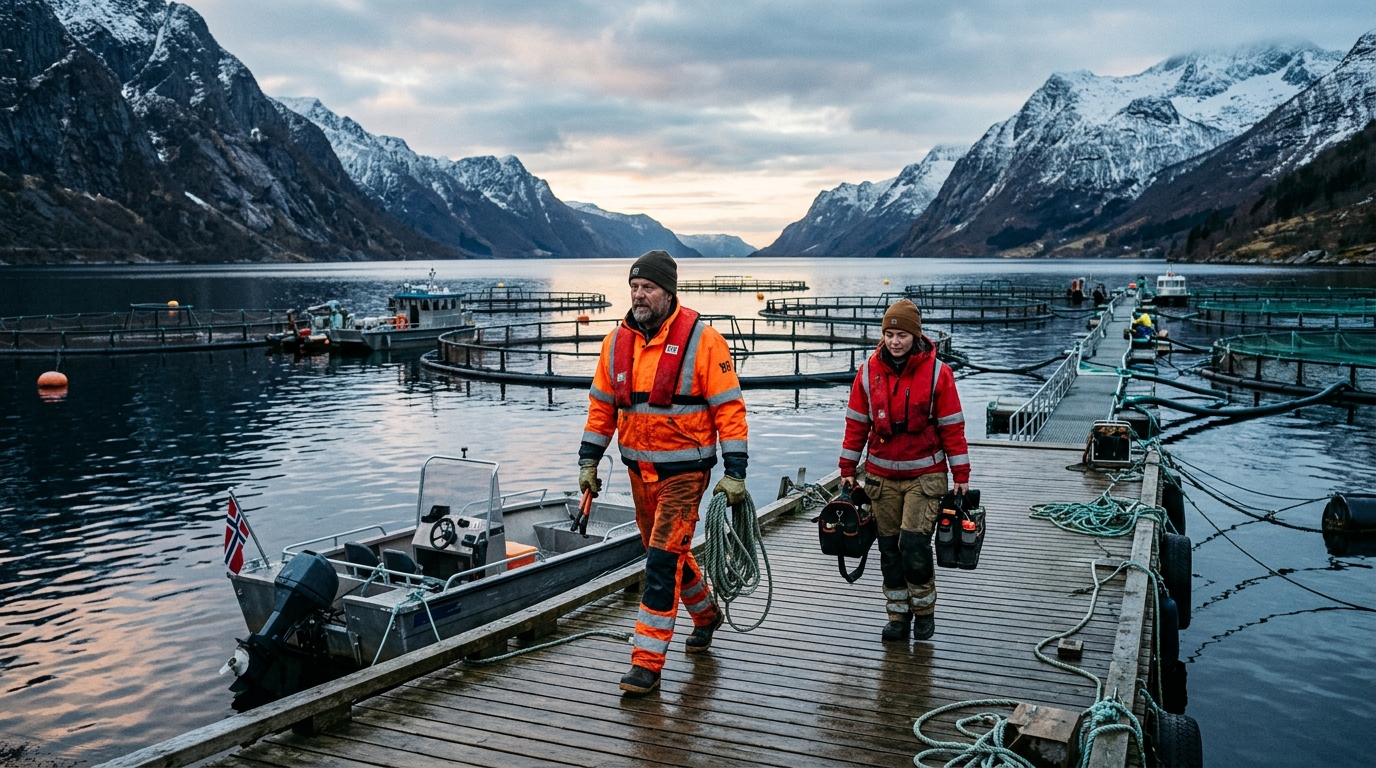
The Hardest-Working People in Norway Are Often the Most Underserved
There is a specific discomfort in noticing a gap that you have the standing and the means to help close, and doing nothing about it.
I have been living on Frøya for the better part of a year. I have watched the industry that sustains this island from close proximity. And one of the clearest things I have seen is a structural mismatch that is not dramatic enough to generate headlines but is significant enough to cost people years of their productive lives.
The people doing the most demanding physical work in Norwegian aquaculture, on the farms, in the processing facilities, on the logistics runs between sites, have among the least access to the physical preparation and recovery support their work requires. The fitness and performance industry is built, almost entirely, for people with predictable working hours, indoor environments, and free time. None of those describe the working life of a production worker on a Norwegian fish farm in winter.
What accountability means here
The Accountability step in the Lion Ethos is not about measuring performance. It is about the honest relationship between what you see, what you say, and what you do.
The easiest response to this kind of gap is observation without commitment. You notice it. You find it unfortunate. You move on. That response costs nothing and changes nothing.
The more demanding response is to ask what your actual standing is and whether it is enough to warrant action. In this case: I run a company that works with Norwegian businesses to close operational gaps using AI and systems thinking. I have built TLE Fitness Lab around the premise that physical discipline is operational infrastructure. The gap I am describing sits directly at the intersection of both.
That does not make the response automatic or easy. It makes the question unavoidable.
Why this is not a charity argument
When I say underserved, I am not reaching for a social justice frame. I am making an operational observation.
Norwegian aquaculture is one of the country's most important export industries. The people doing the physical work that the industry runs on are carrying a documented occupational health risk, cold-environment repetitive work driving musculoskeletal damage that compounds over years, that the broader system has not been designed to address.
The consequence is not abstract. Workers with preventable joint damage leave the industry earlier. The operational knowledge they carry, knowledge that took years to build and cannot be reconstructed quickly, leaves with them. The recruitment and training cost to replace them is significant. The productivity loss during the transition period is real.
This is an operational cost that falls on the industry, on NAV, and on the workers themselves. It is also, in meaningful part, preventable. The research on what structured physical preparation and early intervention can return in reduced absence and extended productive careers in Nordic industrial contexts is not ambiguous.
What a reliable system means in this context
The difference between a system depending on individual effort and one producing outcomes reliably is the core idea here.
The current state of workforce physical health management in most Norwegian aquaculture operations is the first kind. It depends on individual workers knowing enough about their own risk to manage it, and on individual managers noticing physical decline early enough to act. Neither of those are reliable systems. Both fail regularly.
A system that works looks different. It connects the operational data that already exists, shift records, incident logs, absence history, to a detection layer that surfaces patterns before they become formal costs. It routes those signals to structured physical preparation and recovery programs built for the actual demands of the work. It runs continuously rather than depending on anyone noticing at the right moment.
That system is buildable. It does not require new data. It requires connecting data that already exists and building the intervention pathway around what the data surfaces.
The execution question
Execution means doing the work rather than describing it. The consistent execution piece covers what that looks like in practice.
For this specific gap, execution means building the program that the research says is needed and the industry has not yet produced. Not writing about it. Not mapping the opportunity. Building it, testing it with the operations on Frøya and Hitra that have the appetite, and running the pilot long enough to produce the data that makes the broader case.
That is the work on the table. Noticing the gap was the first step. Writing about it is the second. The third is actually closing it.